Introduction
“SEO is dead.”
You’ve heard it. You’ll keep hearing it. And in 2026, it’s still wrong — but the people saying it aren’t entirely making things up. Search has changed dramatically. What looked like traditional SEO just two or three years ago — keyword stuffing, chasing backlinks, optimizing for a single search results page — is genuinely fading. The game has moved.
But here’s the actual truth: <cite index=”19-1″>the average Google Search usage went up to 12.6 sessions per week after people began using ChatGPT. Traditional search has not decreased — instead, the pie has gotten bigger.</cite> SEO isn’t dying. It’s expanding.
<cite index=”17-1″>Almost 70% of Google searches now end with no website clicks, while AI-powered search systems such as ChatGPT, Perplexity, and Google Gemini are growing exponentially.</cite> For website owners and businesses, this means visibility is no longer achieved through Google rankings alone. It now requires a broader strategy — one that covers traditional SEO, AI search, direct answers, and brand authority across multiple platforms.
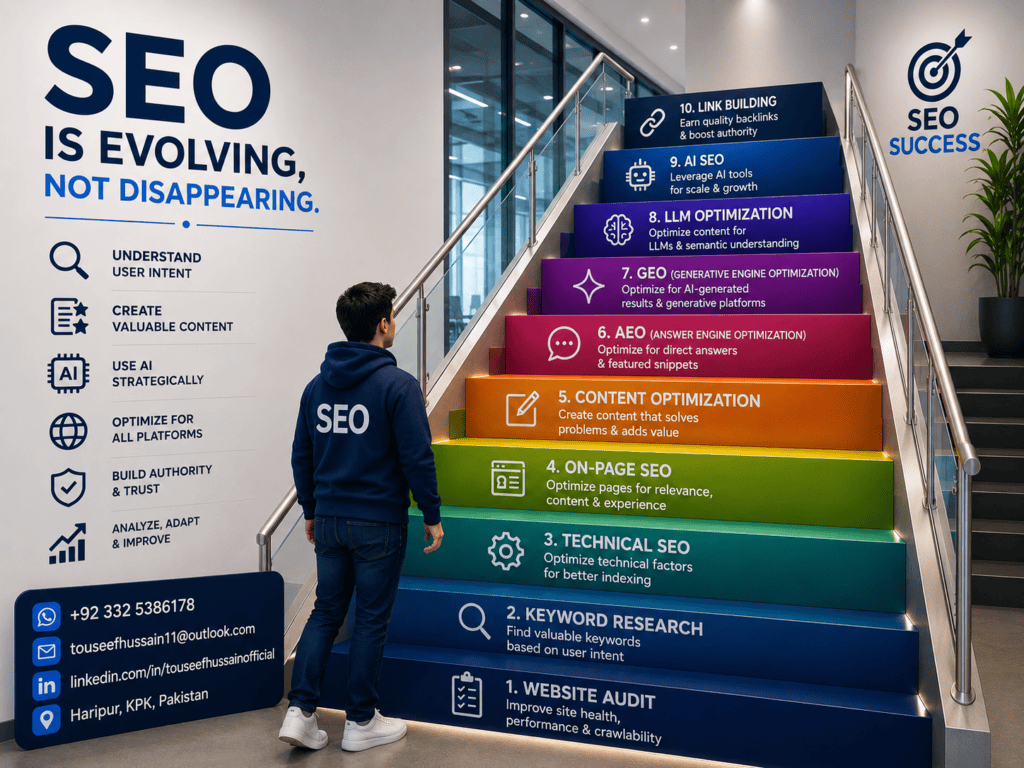
As a freelance WordPress developer who handles SEO setup for every site I build, this is the framework I’m using in 2026 — and it works. Here are the 10 steps to SEO success, explained properly.
Step 1: Website Audit — Fix the Foundation First
You cannot build visibility on a broken foundation. Before any keyword research, content strategy, or link building, the site itself needs to be technically sound.
A proper website audit covers:
- Crawlability — can Google and AI bots actually access and read your pages? <cite index=”18-1″>AI crawlers like GPTBot, ClaudeBot, Perplexity Bot, and Google-Extended do not render JavaScript and need plain-text information.</cite> If your site relies heavily on JavaScript to display content, entire pages may be invisible to AI search systems.
- Site health — broken links, redirect chains, duplicate content, and missing canonical tags all signal low quality to search engines
- Core Web Vitals — Google uses LCP, INP, and CLS as direct ranking signals. Poor performance hurts both rankings and user experience
- Index coverage — confirm in Google Search Console which pages are indexed, which are excluded, and why
What to do: Run a free crawl using Screaming Frog (free up to 500 URLs) or Google Search Console’s Coverage report. Fix critical errors before anything else.
Step 2: Keyword Research — Intent First, Volume Second
Keyword research in 2026 is less about finding high-volume terms and more about understanding exactly what your audience is trying to do when they type or speak a query.
Search intent falls into four categories — informational (learning something), navigational (finding a specific site), commercial (comparing options), and transactional (ready to buy or contact). Every page on your site should be built around one clear intent type.
What has changed: <cite index=”15-1″>traditional keyword targeting is giving way to intent clusters and conversational mapping. Searchers — and AI users — now ask multi-step, natural language questions.</cite>
This means your keyword research needs to go beyond a list of short phrases. Think about the full conversational arc: what does someone ask first, what do they ask next, and where does your page fit in that journey?
Practical tool: Google’s “People Also Ask” boxes are still the fastest free way to find real questions people are asking around your topic. Build your content around these questions, not just a single keyword.
Step 3: Technical SEO — Make Your Site Machine-Readable
Technical SEO ensures both traditional search engines and AI systems can correctly access, understand, and index your content. In 2026, this has a new dimension: <cite index=”18-1″>technical SEO (crawlability, indexation, architecture, Core Web Vitals, structured data) is what makes your content machine-readable for LLM crawlers and AI overview systems.</cite>
Key technical priorities:
- Structured data (schema markup) — tells search engines and AI systems exactly what your content is. FAQPage, Article, Person, Service, and HowTo schemas are the most useful for most websites
- Clean URL structure — short, descriptive, keyword-relevant URLs
- HTTPS/SSL — non-negotiable for trust signals
- XML sitemap — submitted and verified in Google Search Console
- Mobile-first design — Google indexes the mobile version of your site for rankings
- Page speed — every additional second of load time reduces organic traffic
For WordPress sites specifically, my on-page SEO checklist covers the exact technical checks to run on every page before publishing.
[Image suggestion: Google Search Console Coverage report screenshot, alt text: “Technical SEO audit Google Search Console 2026”]
Step 4: On-Page SEO — Relevance and Experience Together
On-page SEO is the work you do directly on each page to signal relevance to both search engines and real visitors. In 2026, Google evaluates pages not just for keywords, but for whether the content genuinely solves the reader’s problem.
Core on-page elements:
- One H1 per page, containing the primary keyword naturally
- Keyword in the first paragraph, URL slug, and at least one H2 subheading
- Meta title under 60 characters, meta description under 160 characters — both unique per page
- Image alt text that describes the image accurately (and includes keyword where genuinely relevant)
- Internal links to related content — at minimum two or three per post
- Outbound links to authoritative external sources
None of this is new. What is new is that Google now cross-references your on-page signals against your broader site’s E-E-A-T — Experience, Expertise, Authoritativeness, and Trustworthiness. <cite index=”15-1″>Entity-based indexing cross-references verified identities, schema, and author bios to assign credibility. “Author rank” — the consistency of expert commentary across platforms — increasingly affects performance.</cite>
Add an author bio with your credentials to every post. Use consistent Person schema. Link to your professional profiles (LinkedIn, portfolio site). These signals matter more than they used to.
Step 5: Content Optimization — Solve Real Problems at the Right Depth
In 2026, the bar for content quality has risen sharply — because AI-generated content is everywhere and most of it is generic. <cite index=”19-1″>When it comes to securing AI mentions and citations, content depth (sentence and word counts) and readability matter most, while traditional SEO metrics like traffic and backlinks have little impact.</cite>
This means your content needs to be:
- Specific — real examples, actual numbers, named tools, personal experience
- Comprehensive — fully answers the question, including related questions the reader will likely have
- Fresh — content that isn’t updated loses rankings over time
- Readable — short sentences, clear structure, scannable with headers and bullets
The format matters too. <cite index=”14-1″>ChatGPT often lifts structured formats like bullet points and FAQs verbatim. Perplexity prioritizes authoritative sources and original data. Google AI Overviews favor FAQ/HowTo schema, short definitions, and visuals.</cite> Writing with these formats in mind helps your content serve multiple surfaces simultaneously.
Step 6: AEO — Answer Engine Optimization
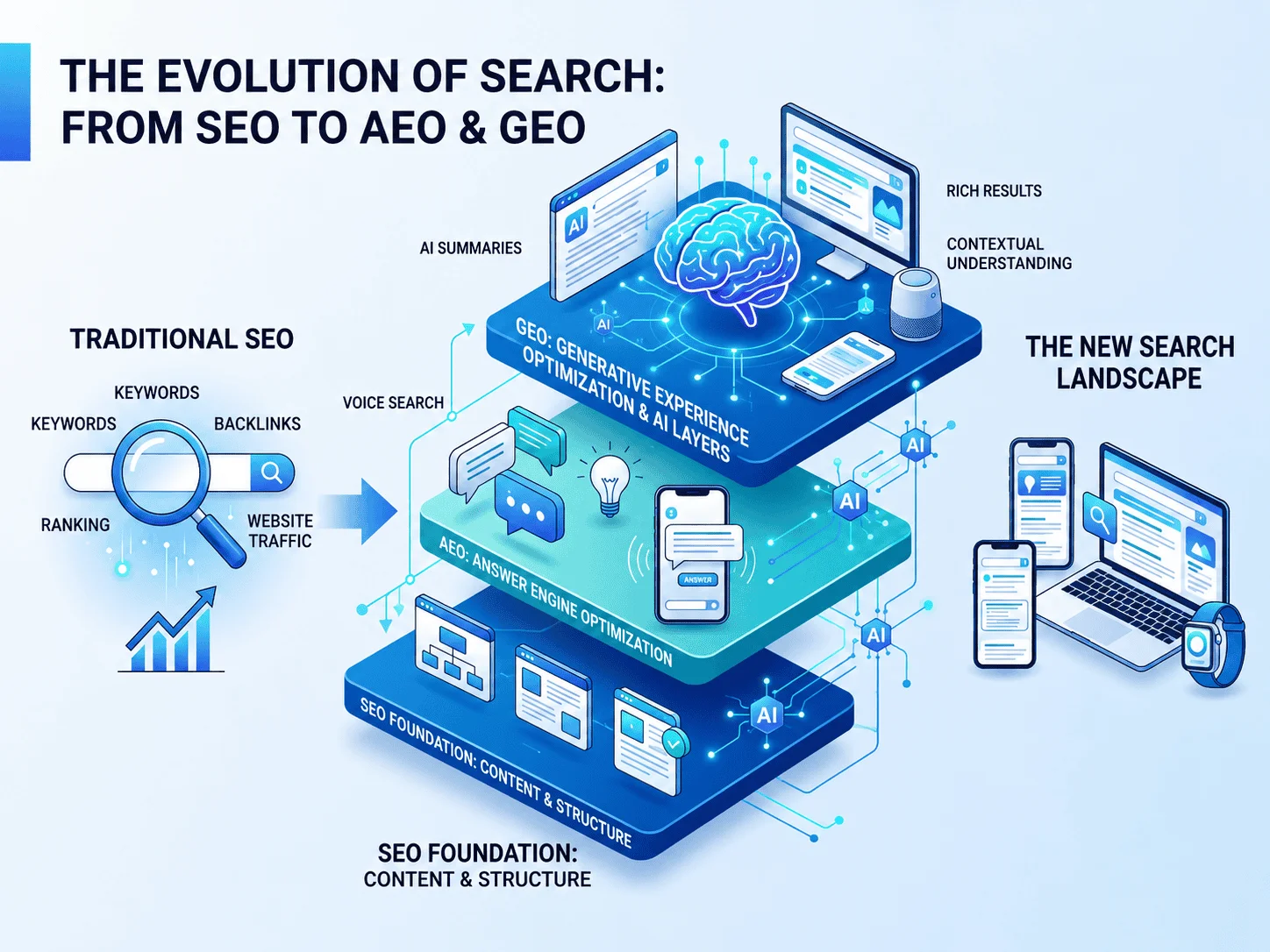
AEO (Answer Engine Optimization) targets the “position zero” — being the direct answer to a specific question, either in Google’s featured snippet box, voice search, or AI-generated summaries.
The key principles of AEO:
- Answer the primary question directly and concisely in the first paragraph — don’t bury the answer
- Use question-format H2/H3 headings (exactly as users would ask them)
- Include an FAQ section at the end of every informational post
- Structure answers in 40–60 word paragraphs — the optimal length for featured snippet extraction
- Use FAQPage schema markup so search engines can correctly parse your Q&A content
<cite index=”16-1″>Nearly a third (31.3%) of the US population will use generative AI search in 2026, pushing marketers to optimize for platforms like ChatGPT, Google AI Overviews, and Perplexity alongside traditional search engines.</cite> AEO positions your content to appear in all of these surfaces — not just Google’s blue links.

Step 7: GEO — Generative Engine Optimization
GEO is the newest layer of the SEO stack — and the most misunderstood. <cite index=”21-1″>Generative Engine Optimization (GEO) is the practice of structuring your content, brand entity, and technical setup so that generative AI engines (ChatGPT, Perplexity, Gemini, Google AI Mode, Google AI Overviews) cite and recommend you when users ask questions.</cite>
Unlike traditional SEO where the goal is ranking in search results, GEO’s goal is being cited as a trusted source inside AI-generated answers.
How to optimize for generative engines:
- <cite index=”15-1″>Break pages into 200–300-word topical chunks with clear headers. Include data points that can serve as standalone citations. Use retrieval-friendly phrasing: direct questions, clear answers, bullet summaries. Refresh pages frequently — recency boosts embedding visibility.</cite>
- Include specific, citable statistics and data points (with source links) — AI systems prefer content they can verify
- Make your brand entity consistent across all platforms — your name, specialty, and location should match across your website, LinkedIn, and any directory listings
- Build presence on platforms that LLMs frequently cite: <cite index=”14-1″>YouTube, Reddit, and LinkedIn are the most frequently cited across AI engines, with each LLM showing its own preferences.</cite>
Step 8: LLM Optimization — Optimize for Semantic Understanding
LLM Optimization (LLMO) focuses on how Large Language Models process, understand, and retrieve your content. It overlaps heavily with GEO but emphasizes the technical and structural side.
<cite index=”17-1″>Best practices for LLMO include: unique structure with H2/H3 headings, consistent entity names, contextual completeness, and schema markup for correct categorization.</cite>
The most practical LLMO improvements for WordPress sites:
- Use consistent entity naming throughout your content — if you’re a “freelance WordPress developer,” use that phrase consistently, not “WordPress freelancer,” “WP developer,” and “web developer” interchangeably
- Add Person schema to your author page and about page linking to verified external profiles
- Ensure your site renders correctly without JavaScript — <cite index=”18-1″>AI agents now browsing on behalf of users do not render JavaScript and require high performance and plain-text information.</cite>
- Implement proper heading hierarchy (H1 → H2 → H3) on every page — LLMs parse document structure to understand content relationships
Step 9: AI SEO — Leverage AI Tools for Scale
AI SEO refers to using AI tools to improve your SEO workflow, content production, and analysis at a scale that wouldn’t be practical manually.
Practical AI SEO applications in 2026:
- Content gap analysis — use AI to identify topics your competitors cover that you don’t
- Schema generation — tools like Yoast’s AI assistant can generate and validate schema markup automatically
- Meta title and description generation — AI-assisted suggestions based on your actual content (not templates)
- Readability editing — AI tools can flag passive voice, long sentences, and unclear phrasing before you publish
- Internal linking suggestions — AI can scan your existing content and suggest where to add links to new posts
The important boundary: AI tools accelerate your SEO work, but they don’t replace judgment. As I covered in detail in my WordPress SEO guide, generic AI-generated content now actively hurts rankings because it floods the internet with thin, undifferentiated text. Use AI to work faster — not to replace real expertise.
Step 10: Link Building — Earn Quality Backlinks and Build Authority
Backlinks remain one of the strongest signals in traditional search, and they’ve taken on new importance in AI search too. <cite index=”18-1″>In 2026, brand visibility in AI search hinges on trust. Earned media — social mentions, reviews, quality backlinks — shapes how AI models and users perceive your brand.</cite>
The shift in 2026 is from quantity to relevance and trustworthiness. Ten backlinks from genuinely relevant, authoritative sites in your niche are worth more than a hundred links from unrelated directories.
Effective link-building approaches for freelancers and small businesses:
- Guest posting on relevant industry blogs — write genuinely useful content in exchange for an author bio with a link
- Resource page links — identify pages that list “helpful resources” in your niche and pitch your best content
- Tool and template creation — free, useful tools and templates attract natural links
- PR and mentions — being quoted as an expert in industry publications builds authority that both Google and LLMs recognize
- Directory listings — legitimate ones (Google Business Profile, LinkedIn, industry directories) build entity authority without spam risk
What to avoid: paid link schemes, link exchanges with irrelevant sites, and any tactic that Google’s link spam documentation explicitly calls out. The risks outweigh any short-term gain.
The Golden Rules That Never Change
Tactics evolve. The fundamentals don’t.
Every search engine — traditional or AI-powered — is trying to do the same thing: connect a person who has a question with the most trustworthy, relevant, and useful answer available. If your content is genuinely the most useful answer to a specific question, and your site is technically sound, and your brand has established trust signals across multiple platforms — you rank. You get cited. You win.
The specific formats change. AEO, GEO, LLMO — these are all real and worth implementing. But they are layers on top of the same foundation: understand what your audience actually needs, create content that genuinely delivers it, and build a brand that earns trust over time.
As a freelance WordPress developer, I apply this exact framework to every site I build and maintain. If you want a site that’s structured for both traditional search and AI visibility from day one, take a look at my services.
FAQs
Q: Is SEO really not dead in 2026? A: No. Search volume is higher than ever, and traditional Google rankings still drive the majority of website traffic. What has changed is that AI search platforms (ChatGPT, Perplexity, Google AI Overviews) are now an additional layer of visibility that sites need to optimize for — alongside, not instead of, traditional SEO.
Q: What is the difference between AEO and GEO? A: AEO (Answer Engine Optimization) focuses on appearing as the direct extracted answer in featured snippets, voice search, and AI Overviews. GEO (Generative Engine Optimization) focuses on being cited as a trusted source inside full AI-generated responses on platforms like ChatGPT and Perplexity. In practice, most of the tactics overlap.
Q: Does WordPress support AEO and GEO optimization? A: Yes — WordPress with Yoast SEO handles schema markup (FAQPage, Article, Person), structured headings, sitemap generation, and meta tag optimization automatically. These are the technical foundations that both AEO and GEO build on. My on-page SEO checklist walks through the full setup.
Q: How long does SEO take to work in 2026? A: For new sites, expect 3–6 months before significant organic traffic appears, assuming the fundamentals are done correctly. For existing sites with an established domain, well-optimized new content can rank within weeks. AI citations (GEO) can happen faster than traditional rankings because LLMs update their training and retrieval indexes more frequently than Google’s full index cycle.
Q: What’s the single most important SEO change to make in 2026? A: Structure your content to answer specific questions directly and completely. Every page should answer one clear question with a direct response near the top, supporting evidence in the body, and an FAQ section at the end. This single structural change improves traditional rankings, featured snippet inclusion, and AI citation likelihood simultaneously.
Related Posts You Might Like
- WordPress SEO in 2026: What Actually Works (And What Doesn’t Anymore)
- On-Page SEO Checklist for WordPress Websites in 2026
- How AI Is Transforming WordPress in 2026
- Modern Website Design Trends in 2026
Want your WordPress site optimized for both traditional search and AI visibility? Let’s talk — I’ll build it right from the start.