Introduction
WordPress SEO in 2026 looks very different from what it looked like just two or three years ago. The tactics that used to move the needle — stuffing keywords into every heading, chasing exact match phrases, building thin content quickly — no longer work. In many cases, they actively hurt your rankings.
At the same time, the fundamentals have become more powerful than ever: fast-loading pages, genuinely helpful content, clean site structure, and strong internal linking are delivering better results than most “advanced” tactics.
This guide cuts through the noise. As a freelance WordPress developer who works with sites every day, I’ll walk you through what WordPress SEO strategies are actually working in 2026, what you should stop doing, and exactly what to focus on next.
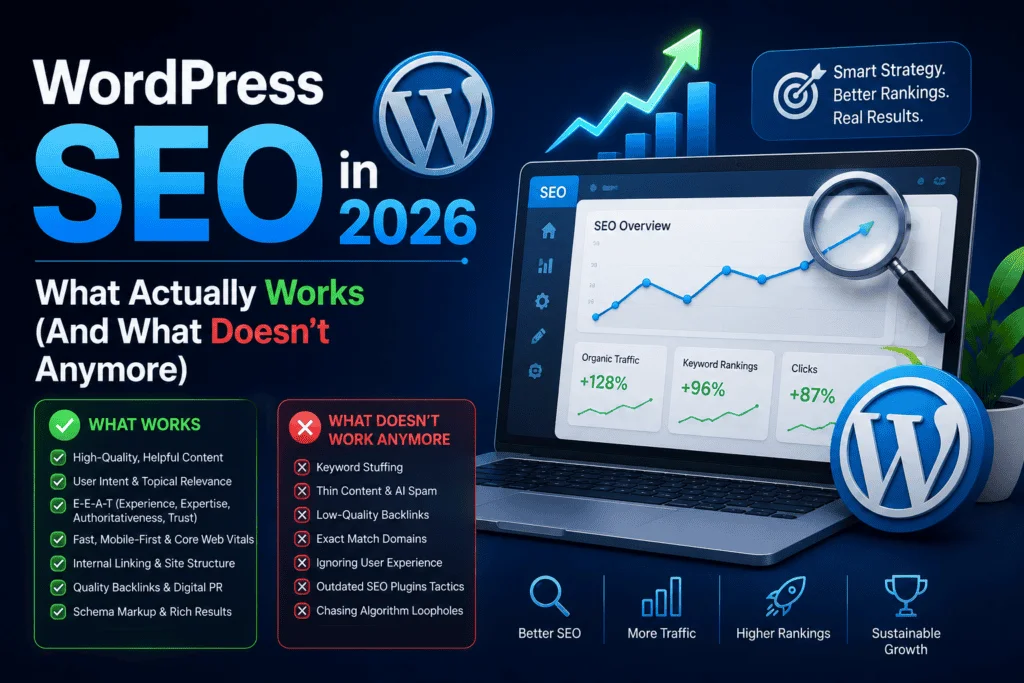
[Image suggestion: WordPress dashboard with SEO analytics open, alt text: “WordPress SEO strategy 2026”]
What Has Changed in WordPress SEO in 2026
Before getting into tactics, it helps to understand what has shifted.
Search engines are smarter about intent. Google no longer just matches keywords — it evaluates whether your page actually answers the question someone had when they searched. A page that mentions a keyword 15 times but doesn’t clearly solve the reader’s problem will consistently lose to a shorter, more focused page that does.
AI-generated content is everywhere. That means generic, surface-level content is now worthless. What stands out is content with real specificity — specific examples, actual screenshots, personal experience, and opinions grounded in expertise.
Page experience is a direct ranking factor. Loading speed, mobile usability, and visual stability (Core Web Vitals) are baked into how Google ranks pages — not as a bonus, but as a baseline requirement.
Zero-click searches are rising. More search results now show the answer directly on Google’s results page. This makes it more important to rank for terms where people actually click through — and to structure your content in ways that can earn featured snippets.
What Actually Works in 2026
1. Matching Search Intent — Not Just Keywords
The most impactful SEO shift of the last two years is also the most overlooked: before writing any piece of content, search the keyword on Google and study what’s already ranking.
If the top results are all step-by-step tutorial guides, write a step-by-step tutorial guide — not a comparison post or a short opinion piece. If the top results are listicles with 10–15 items, that’s the format Google believes best answers the query.
Intent matching is more important than keyword density, meta tag optimization, or most other on-page factors. Get this wrong and no amount of technical SEO will help the page rank.
2. Content That Proves Real Experience (E-E-A-T)
Google’s E-E-A-T framework — Experience, Expertise, Authoritativeness, and Trustworthiness — has become one of the most important signals in 2026, especially as AI-generated content floods the web.
What this means practically:
- Include real examples from your own work — screenshots, case studies, before/after comparisons
- Cite your sources when making data-backed claims
- Add an author bio with your credentials to every post
- Show the date the content was last updated
- Write in a specific, opinionated voice — not generic “best practices” language
Content that could have been written by anyone, about anyone, for anyone — will consistently rank below content that demonstrates real, specific knowledge.
3. Site Speed and Core Web Vitals
Page speed has always mattered for SEO. In 2026, it matters more — and Google measures it more precisely through Core Web Vitals:
- LCP (Largest Contentful Paint): How fast the main content loads. Target: under 2.5 seconds
- INP (Interaction to Next Paint): How responsive the page is to clicks and taps. Target: under 200ms
- CLS (Cumulative Layout Shift): How much the page “jumps around” as it loads. Target: under 0.1
For WordPress sites, the fastest speed wins come from:
- Switching to a lightweight theme (Hello Elementor, Astra, or GeneratePress)
- Installing a caching plugin (LiteSpeed Cache is excellent and free for Hostinger users)
- Compressing all images and using WebP format (ShortPixel handles this automatically)
- Removing plugins you don’t actively use — each one adds load time
- Using a CDN (Cloudflare’s free plan serves your assets faster globally)
Check your scores anytime at Google PageSpeed Insights — it’s free and gives you a prioritized list of what to fix.
4. Internal Linking Done Right
Internal linking is one of the most underrated SEO levers available in WordPress — and it’s entirely within your control. Done well, it helps Google understand your site’s structure, spreads authority across pages, and keeps visitors on your site longer.
What works in 2026:
- Every new post should link to two or three genuinely related posts on your site
- Use descriptive anchor text — “read my Wordfence security guide” instead of “click here”
- Create “hub” pages for your main topics — a central page that links out to all related detailed guides
- Revisit older posts regularly and add links to newer content you’ve published
- Fix orphaned pages (pages with no internal links pointing to them) — they’re invisible to both users and search engines
Internal linking is one of the most underrated SEO levers in WordPress because it is within your control and compounds over time. The results aren’t instant, but they are steady and durable.
5. Schema Markup (Structured Data)
Schema markup is code that tells search engines exactly what your content is — an article, a FAQ, a how-to guide, a product, a review. In 2026, it has become more important as Google uses structured data to populate AI-generated search results and featured snippets.
Most useful schema types for a WordPress portfolio/blog:
- Article schema — for all blog posts
- FAQ schema — add a FAQ section at the end of posts and mark it up with schema
- Person schema — for your author page and about page
- BreadcrumbList schema — helps Google understand your site hierarchy
Yoast SEO handles Article and BreadcrumbList schema automatically. For FAQ schema, add a question-and-answer section at the bottom of your posts and use Yoast’s FAQ block, which adds the schema automatically.
Implementing structured data helps search engines understand the meaning and context of your content in addition to the keywords on the page, which can improve visibility in rich results and AI-generated summaries.
6. Optimizing for AI Search (AEO)
This is the emerging frontier of SEO in 2026. AI-powered search tools — including Google’s AI Overviews, Bing Copilot, and standalone tools like ChatGPT and Perplexity — are increasingly surfacing answers directly to users without requiring them to click a link.
To have your content cited by these tools, your pages need to be:
- Clearly structured — short paragraphs, descriptive headings, logical flow
- Direct and specific — answer the question clearly near the top, before elaborating
- Well-cited — link to authoritative sources; this signals trustworthiness to AI systems
- Schema-marked — structured data helps AI tools understand and extract your content
This doesn’t require a completely different content strategy. It requires being more precise and more structured in how you present information — which also happens to make your content more useful for human readers.
7. Yoast SEO as a Publishing Workflow Tool
Yoast SEO has become a control layer for content teams that need help with on-page SEO checks, XML sitemaps, schema markup, crawl settings, redirects, internal links, and publishing discipline inside WordPress.
In 2026, the most effective way to use Yoast SEO is as a publishing checklist — not as a goal in itself. Getting every indicator green is useful, but it doesn’t guarantee rankings. What Yoast actually ensures is that you haven’t made basic mistakes: missing meta descriptions, no focus keyphrase, no internal links, no alt text.
Think of the green bullets as a minimum bar — not a finish line.
What Doesn’t Work Anymore
Keyword stuffing. Repeating your focus keyword in every paragraph doesn’t signal relevance — it signals low-quality content. Natural keyword usage in context is what works.
Thin content. Short posts that skim the surface of a topic consistently lose to comprehensive guides that cover the topic fully. If you can’t write at least 800–1,000 words of genuinely useful content on a topic, it’s probably not worth targeting as a standalone post.
Exact-match anchor text everywhere. Using “freelance WordPress developer” as the anchor text for every internal link looks manipulative. Vary your anchor text naturally.
Ignoring mobile. With mobile-first indexing fully established, a site that works perfectly on desktop but loads slowly or breaks on mobile will rank below its potential regardless of how well everything else is optimized.
Publishing and forgetting. Content that isn’t refreshed loses rankings over time. Google favors content that stays current. Revisit your top posts every six months — update statistics, add new sections, refresh internal links.
A Practical WordPress SEO Priority List for 2026
If you’re starting from scratch or auditing an existing site, work through these in order:
- Fix technical foundations first — site speed, mobile usability, SSL, sitemap submitted to Google Search Console
- Install and configure Yoast SEO — set up site title, meta description, schema, and XML sitemap
- Map one primary keyword to each page — no two pages targeting the same keyword
- Match search intent before writing — study what’s ranking, then create the best version of that format
- Build internal links — every post linked to at least two or three related pages
- Add schema markup — especially FAQ schema on informational content
- Refresh content regularly — revisit top posts every quarter
Final Thoughts
WordPress SEO in 2026 rewards the same things it always has — useful, well-structured, fast-loading content that genuinely serves the searcher. What’s changed is the bar. Generic content no longer earns rankings. Surface-level optimization no longer differentiates you. Speed that used to be “good enough” now gets you penalized on mobile.
The good news: if you focus on the fundamentals — fast site, clear content, strong structure, real expertise — you’re already ahead of the majority of WordPress sites that are still chasing outdated tactics.
As a freelance WordPress developer, I build sites around these principles from day one. If you want help building or auditing a WordPress site that’s genuinely optimized for 2026, get in touch.
Related Posts You Might Like
- On-Page SEO Checklist for WordPress Websites in 2026
- How AI Is Transforming WordPress in 2026
- WordPress Security in 2026: The Complete Wordfence Setup Guide
Found this useful? Share it with a fellow WordPress site owner — the fundamentals don’t change, but the details do.