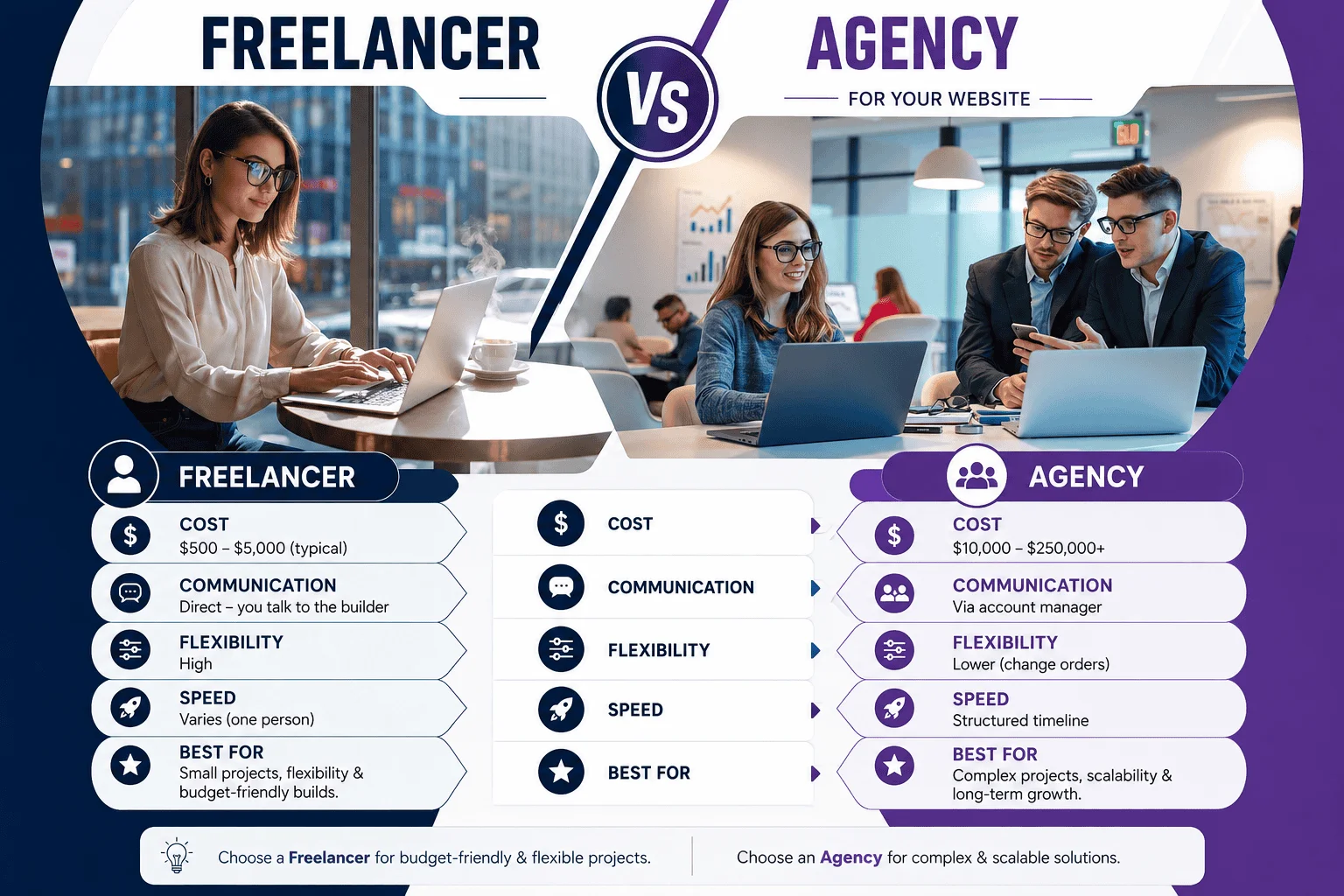
Introduction
You need a website. You have two main options: hire a freelancer or hire an agency. Both can build you a website. Both have real advantages. And both have genuine risks that most comparison articles gloss over.
This guide gives you the honest version — what each option actually costs in 2026, where each one genuinely wins, where each one quietly fails, and exactly which choice makes sense for your specific situation. No agency sponsorships. No freelancer bias. Just the real comparison.
The Core Difference
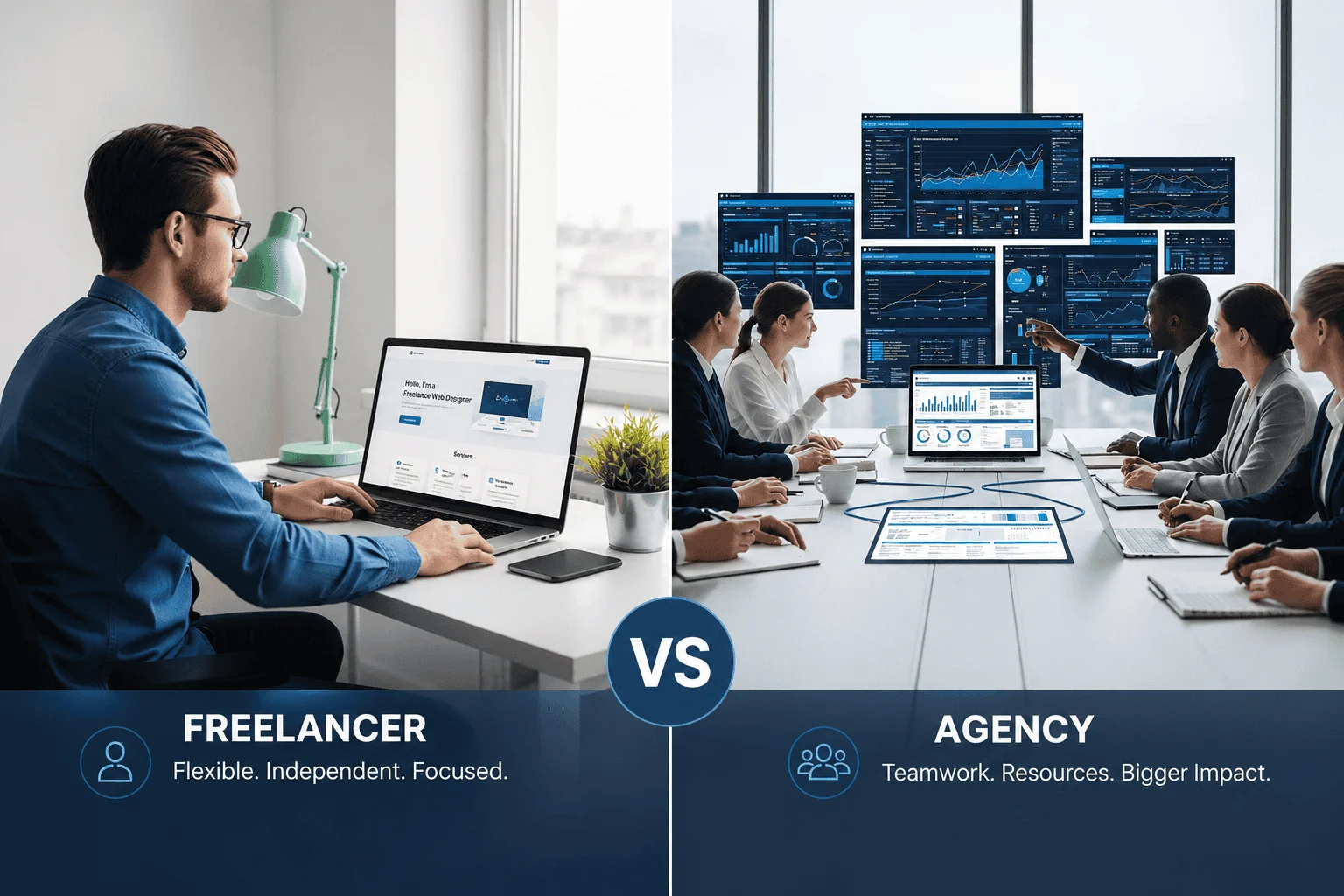
The fundamental difference is simple: freelancer is one person. An agency is a team.
Everything else — cost, speed, quality, risk, support — flows from that one fact. A freelancer brings focused individual attention and lower overhead. An agency brings structured processes, specialist roles, and team continuity. Neither is universally better. The right choice depends on what your project actually needs.
What Does Each Option Actually Cost?
Cost is usually the first question. Here’s what the market actually looks like in 2026.
Freelancer rates:
A freelance web developer typically charges $30 to $120 per hour. Project fees for a basic site run from roughly $1,500 to $5,000.For a simple portfolio or small business site, a good freelancer can often deliver for $500 to $2,000.
Agency rates:
Agencies charge $90 to $300 per hour because they bake in project managers, designers, QA teams, and overhead.Fixed project prices for full website builds typically start at $10,000 and can reach $250,000 or more for complex platforms.
The hidden cost question:
Agency vs freelancer cost looks simple at first because the freelancer rate is often lower. The real comparison is what that rate buys. Does it include discovery, design review, technical SEO, QA, deployment, backup support, and fixes after launch? Usually not.
That does not automatically make agencies better. It means you need to compare total delivery — not just the headline number.

Freelancer: Where It Genuinely Wins
1. Cost — Especially for Smaller Projects
For solo operators, local businesses with simple needs, and very tight budgets, a freelancer is usually the most cost-effective option.For a small marketing site, a freelancer can save you 40 to 60 percent compared to agency rates.
If your project is a portfolio site, a small business website, a landing page, or a simple WooCommerce store — and your budget is under $3,000 — a skilled freelancer will almost always give you better value than an agency at the same price point.
2. Direct Communication
With a freelancer, you talk directly to the person building your site. No account managers relaying messages. No internal miscommunication between designers and developers. What you say is what gets implemented.
For small teams and solo business owners, this directness is a genuine advantage. It speeds up decisions and reduces the friction that can slow agency projects down.
3. Flexibility
Freelancers adapt. If your scope changes mid-project, a freelancer can usually adjust without triggering a formal change order process. For projects where requirements evolve — which is most projects — this flexibility has real value.
4. Focused Attention
A freelancer working on your project is working on your project.Freelancers offer hands-on work without extra staff, and this setup suits small tasks or tight budgets. You are not sharing attention with fifteen other client accounts being managed simultaneously by different team members.
Agency: Where It Genuinely Wins
1. Complex Projects
Hiring a web design agency makes the most sense when you have a high-stakes project, need a full team with complementary skills (SEO, content, development), have tight deadlines, or are building something with custom features like a member portal or advanced e-commerce store.
If your site directly generates revenue, processes payments at scale, requires custom integrations, or involves multiple stakeholders — agency structure reduces delivery risk in ways a solo freelancer structurally cannot.
2. The Boring-But-Important Parts
Where agencies do tend to win on quality consistently: accessibility (WCAG compliance) — solo freelancers skip this 70% of the time — cross-browser and cross-device QA, security hardening, and post-launch monitoring. These are not exciting, but they are the things that cause problems six months after launch.
A great freelancer does all of these. A mid-tier one often doesn’t — and won’t tell you they didn’t.
3. Continuity
If your freelancer gets sick, takes on too many clients, or simply stops responding — your project stalls.With an agency, even if a project manager leaves, the agency continues supporting you. Team continuity is a genuine advantage for ongoing or long-term projects.
4. Consistent Quality Control
Agencies have internal review processes — designers reviewing developers’ implementations, project managers checking against the brief.Quality is more consistent because a team reviews the work against standards.With a freelancer, quality depends entirely on that individual.
Side-by-Side Comparison
| Factor | Freelancer | Agency |
|---|---|---|
| Cost | $500 – $5,000 (typical) | $10,000 – $250,000+ |
| Hourly Rate | $30 – $120/hr | $90 – $300/hr |
| Communication | Direct — you talk to the builder | Via account manager |
| Speed | Varies (one person) | Structured timeline |
| Quality | High variance | More consistent |
| Flexibility | High | Lower (change orders) |
| Risk | Single-point failure | Team continuity |
| Support | Depends on individual | Usually structured |
| QA/Testing | Often limited | Usually included |
| Accessibility | Often skipped | Usually covered |
| Best for | Budget under $3K, simple sites | Complex builds, $5K+ budgets |
Who Should Choose a Freelancer?
Choose a freelancer when:
- Your budget is under $3,000
- Your project is a portfolio, landing page, or simple 5–8 page business website
- You can define the scope clearly upfront and keep it stable
- You want direct communication with the person building your site
- Speed and flexibility matter more than structured process
- You have some ability to review and QA the work yourself
Most small businesses with revenue under $500,000 get better value from a freelancer — cheaper rates, good enough quality for the size of project.
Who Should Choose an Agency?
Choose an agency when:
- Your budget is $5,000 or more
- Your website directly generates significant revenue
- The project involves complex functionality, integrations, or multiple stakeholders
- You need a team with complementary skills (design, development, SEO, copywriting) handled together
- You cannot afford the risk of the project stalling or going off-track
- You want ongoing support under a formal service agreement
For projects where the website is your primary source of revenue and you need the best people to ensure its success — or where the project is too complex for one person to handle alone — an agency is the appropriate choice.
The Third Option Most People Overlook
For most small and medium businesses in 2026, the right answer is neither a pure freelancer nor a full agency. It is a founder-run studio — a small business of two to five people where the founders do the work themselves. This model offers agency-grade quality at freelancer-grade pricing because there is no account management layer, no junior teams, and no overhead being passed to the client.
As a freelance WordPress developer, this is exactly how I operate — direct client communication, professional processes, individual accountability, and no overhead passed to you. You work with me directly, get the same quality discipline a structured team delivers, and pay rates that reflect the absence of agency overhead.
If you want to understand what’s included in a properly delivered WordPress project, my services page covers exactly what each package delivers.

Questions to Ask Before You Decide
Whether you’re evaluating a freelancer or an agency, ask these before signing anything:
About the work:
- Can I see examples of completed projects similar to mine?
- Will I be able to update the site myself after launch?
- What platform are you building on, and why?
About the process:
- How many rounds of revisions are included?
- How do you handle scope changes?
- What’s the timeline, and what are the milestone checkpoints?
About ownership and handover:
- Who owns the files, domain, and accounts after the project is complete?
- What happens if there’s a bug or issue after launch?
About ongoing needs:
- Do you offer maintenance after launch?
- What does ongoing support cost?
Common Mistakes to Avoid
Choosing purely on price. The cheapest option rarely delivers the best value. A $300 website that requires $2,000 of fixes six months later was not cheap.
Not defining scope upfront. Vague briefs produce vague results — with both freelancers and agencies. The more specifically you define what you need, the less room there is for misalignment.
Skipping the contract. Always use a written agreement — scope, timeline, payment terms, revision limits, ownership. This protects both sides regardless of who you hire.
Ignoring post-launch support. A website needs updates, security patches, backups, and occasional fixes. Know what’s included and what it costs before you sign, not after launch.
Final Answer: Which Is Better?
There is no wrong choice — just a right-for-now choice. If you’re a startup or small business with a tight budget and a defined project, a freelancer is usually the stronger option. If you’re an established brand building something complex that directly drives revenue, an agency brings the structure and coverage the project needs.
For most small businesses building their first professional website, a skilled freelancer on a clear, scoped project will deliver better value — faster, more directly, and at a fraction of the cost.
The key word is skilled. Spend time on the portfolio, ask the right questions, use a contract, and structure payments in milestones. Do that and a freelancer hire is genuinely low-risk for the right project.
FAQs — Freelancer vs Agency for Website
Q: Is a freelancer or agency better for a small business website? A: For most small business websites — 5–8 pages, budget under $3,000 — a skilled freelancer delivers better value. Lower rates, direct communication, and focused attention on your project. An agency makes sense when the project is complex, the budget is above $5,000, or the site directly drives significant revenue.
Q: How much does a freelancer charge for a website in 2026? A: Freelance web designers typically charge $30–$120 per hour. Flat-rate project fees for a basic business website range from $500 to $5,000 depending on scope, platform, and what’s included. Always clarify what’s covered — design only, or design plus development, SEO setup, and post-launch support.
Q: How much does an agency charge for a website in 2026? A: Agency rates typically start at $90–$300 per hour. Full website projects usually start at $10,000 and go up significantly for complex builds. The higher cost reflects project management, specialist teams, QA processes, and ongoing support structures.
Q: What’s the risk of hiring a freelancer for my website? A: The main risks are single-point failure (if the freelancer becomes unavailable, work stops), higher quality variance than a structured agency team, and limited QA on accessibility and cross-browser testing. Mitigate these by checking references, using a contract, paying in milestones, and ensuring you own all files and accounts at the end.
Q: Can a freelancer match agency quality? A: Yes — the best freelancers match or exceed agency quality on craft. The gap appears on the process side: QA, accessibility checks, security hardening, and post-launch monitoring. A senior freelancer who takes these seriously will out-deliver a junior-led agency team. Ask specifically about these areas before hiring.
Q: What should I own after a website project is complete? A: Everything. Your domain, hosting account, WordPress files, all login credentials, Google Analytics, Search Console, and any form submission data. This should be in writing before work begins — not assumed after completion.
Related Posts You Might Like
- Modern Website Design Trends in 2026
- How to Hire a Fresher Web Designer in 2026
- On-Page SEO Checklist for WordPress Websites
- WordPress Security in 2026: The Complete Wordfence Setup Guide
Looking for a WordPress developer who works like a studio — direct communication, professional processes, no agency overhead? Get in touch and let’s talk about your project.